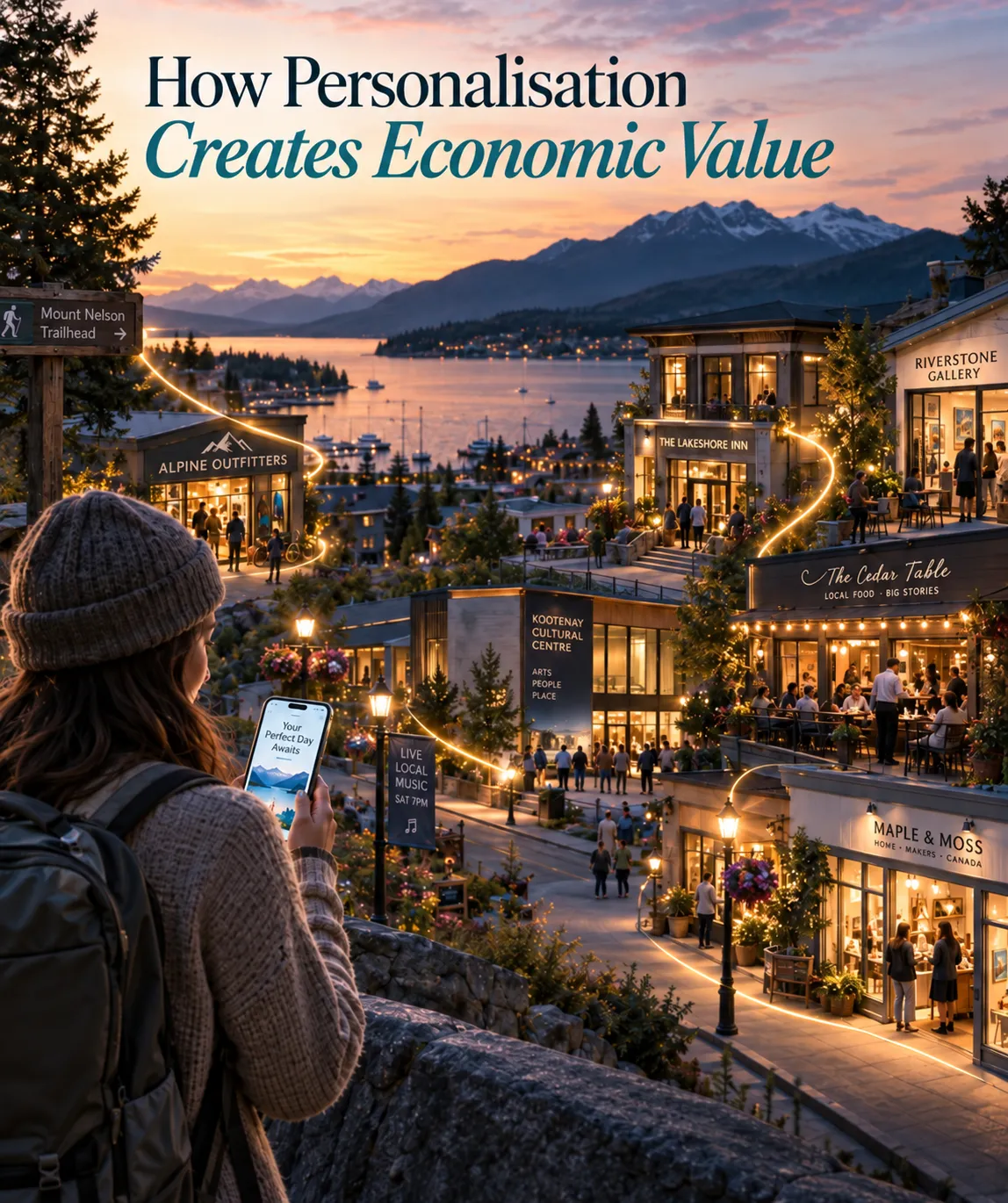
How Personalisation Creates Economic Value
One of the things I’ve become increasingly convinced of while building Roamlii is that personalisation has economic consequences.
Travel is intensely personal. Two people can stand in the same destination, on the same day, with completely different ideas of what would make the trip worthwhile.
One wants a challenging trail. Another wants somewhere accessible to take their parents. Someone else is looking for live music, a quiet restaurant, Indigenous history, Ukrainian culture, a great fishing spot or something their six-year-old will talk about for weeks.
When we give all of them roughly the same recommendations, a lot of potentially valuable connections never happen.
That matters for the traveller, but it also matters for the businesses sitting further down what’s often called the long tail.
Most destinations have a relatively small number of attractions and businesses that almost everybody knows. Behind them are dozens, hundreds, sometimes thousands of smaller experiences that individually appeal to narrower audiences.
Those businesses don’t need to appeal to everyone.
They need to be discovered by the people they’re genuinely right for.
That’s where personalisation becomes economically interesting.
If better discovery connects someone with another activity they’d love, a restaurant that matches their tastes, an event happening during their stay or something worthwhile twenty minutes down the road, relevance starts turning into spending.
Maybe they add an experience. Maybe they drive into another part of the region. Maybe they buy something they hadn’t planned on. Maybe they stay another night.
Multiply those little decisions across thousands of visitors in a single season and suddenly the economic effect isn’t so little.
It also gives us a much better way to learn.
Every save, skip, booking, preference, itinerary change and piece of feedback tells us something about what that traveller values. Over time, sentiment-based learning can make discovery progressively more relevant instead of continually pushing the same popular inventory toward everyone.
That creates an interesting cycle.
Better relevance helps visitors discover more of what matters to them. More businesses get a chance to participate. Visitor spending reaches further into the community. And every interaction gives the system more context for what might be useful next.
Personalisation doesn’t create the inventory. The experiences, businesses and communities are already there.
It helps more of that existing inventory find its audience.
And when thousands of small, relevant connections start happening across the long tail, something that once looked like scattered niche demand begins to look a lot more like an economy.
Ready to support the sector that supports us all?
#GetRoaming and let’s build a more connected, resilient, and thriving Canada, one traveller, one town, one story at a time.
Yours in tourism, innovation and startups,

Founder and CEO, Roamlii