Why I Started Thinking About Discoverability as Infrastructure
One of the biggest shifts in how I think about Roamlii came when I stopped seeing discoverability as a marketing problem.
For years, tourism technology has largely been placed inside the promotion box. A community wants more visitors, so it builds a website, runs campaigns, publishes content and tries to generate attention.
Those things matter, but they don’t solve the whole problem.
I kept seeing communities with exceptional accommodations, events, trails, restaurants and experiences that were still incredibly difficult to understand as a visitor, and all entirely disconnected from one another. The information existed, but it was dispersed across regional websites, operator pages, social channels, event calendars and booking systems that didn’t connect with one another.
A visitor could find one attraction and still have no clear sense of where to stay, what else was nearby, whether anything was open, or how the pieces might fit into a worthwhile trip.
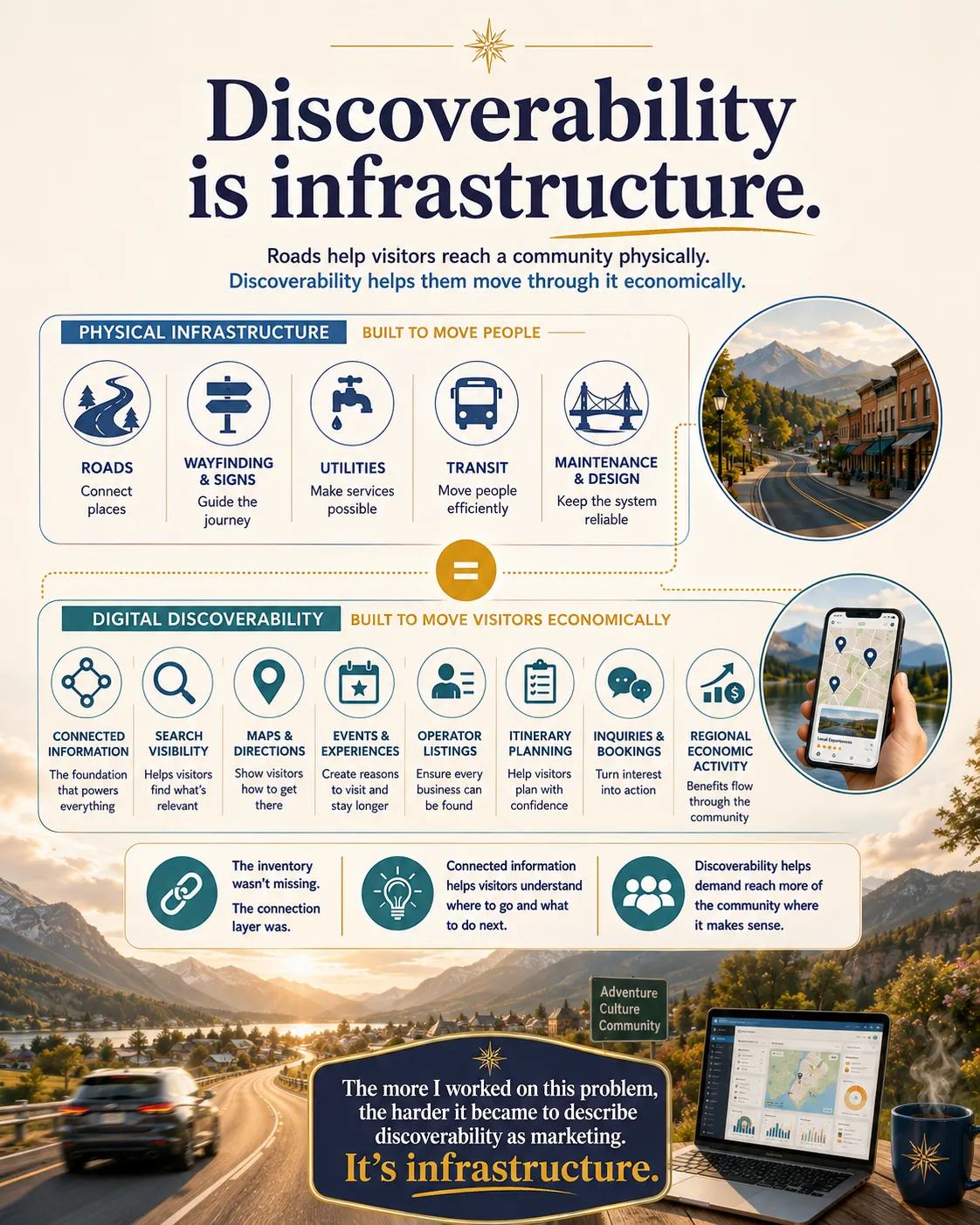
The inventory wasn’t missing. The connection layer was.
That distinction changed the way I looked at the problem.
We understand roads, utilities, signs and public transport as infrastructure because they help people move through a place. In a digital visitor economy, accurate and connected information serves a similar purpose. It helps people understand where to go, what’s available, what suits them and what action to take next.
Without that layer, valuable experiences can remain functionally inaccessible even when they’re sitting right in front of us.
𝗧𝗵𝗮𝘁’𝘀 𝘄𝗵𝗲𝗻 𝗜 𝘀𝘁𝗮𝗿𝘁𝗲𝗱 𝘁𝗵𝗶𝗻𝗸𝗶𝗻𝗴 𝗮𝗯𝗼𝘂𝘁 𝗱𝗶𝘀𝗰𝗼𝘃𝗲𝗿𝗮𝗯𝗶𝗹𝗶𝘁𝘆 𝗮𝘀 𝗶𝗻𝗳𝗿𝗮𝘀𝘁𝗿𝘂𝗰𝘁𝘂𝗿𝗲.
It isn’t only about showing more businesses to more people. It’s about helping the right visitors find relevant options, connect them into workable itineraries and move confidently from interest to booking, attendance, directions or inquiry.
It also has to be managed responsibly. Better discovery shouldn’t mean flooding every sensitive place with unlimited demand. Communities need the ability to account for seasonality, capacity, closures, resident priorities and the kinds of visitors different places are prepared to welcome.
The goal isn’t maximum visibility everywhere. It’s a stronger, more useful discovery system that helps demand reach more of the community where it makes sense.
Much of Roamlii’s evolution has grown from this thinking. The opportunity isn’t simply to build another directory or promotional channel. It’s to create stronger digital pathways between local inventory, visitor planning and measurable economic activity.
Roads help visitors reach a community physically. Discoverability helps them move through it economically.
The more I’ve worked on this problem, the harder it’s become to describe that as marketing. 𝗜𝘁’𝘀 𝗶𝗻𝗳𝗿𝗮𝘀𝘁𝗿𝘂𝗰𝘁𝘂𝗿𝗲.
Ready to support the sector that supports us all?
#GetRoaming and let’s build a more connected, resilient, and thriving Canada, one traveller, one town, one story at a time.
Yours in tourism, innovation and startups,

Founder and CEO, Roamlii